
Trusted Messenger Ecosystem
The Problem Institutions spend millions trying to reach communities that don't trust them. Traditional communications, no matter how well-funded or well-designed, cannot substitute for the voice of someone a community already knows and believes. The gap between civic systems and the people those systems are meant to serve is not a messaging problem. It is a trust problem. And trust cannot be manufactured from the outside.
What We Do The Ditas Group designs and builds trusted-messenger ecosystems that close that gap. Drawing on the model Ditas Katague created in California in 1999 and has refined across three census cycles and national federal operations, we help clients identify the right community-rooted messengers, build the partnership architecture that activates them, and create the engagement logic that connects institutional goals to community trust. We do not drop messengers into an existing communications plan. We build the infrastructure that makes the messengers work.
What You Walk Away With
A fully mapped trusted-messenger network tailored to your target communities. A partnership architecture that defines roles, resources, and accountability across government, philanthropy, and community-based organizations. A layered engagement framework your team can activate, sustain, and scale. And the institutional relationships that make it all possible long after our engagement ends.
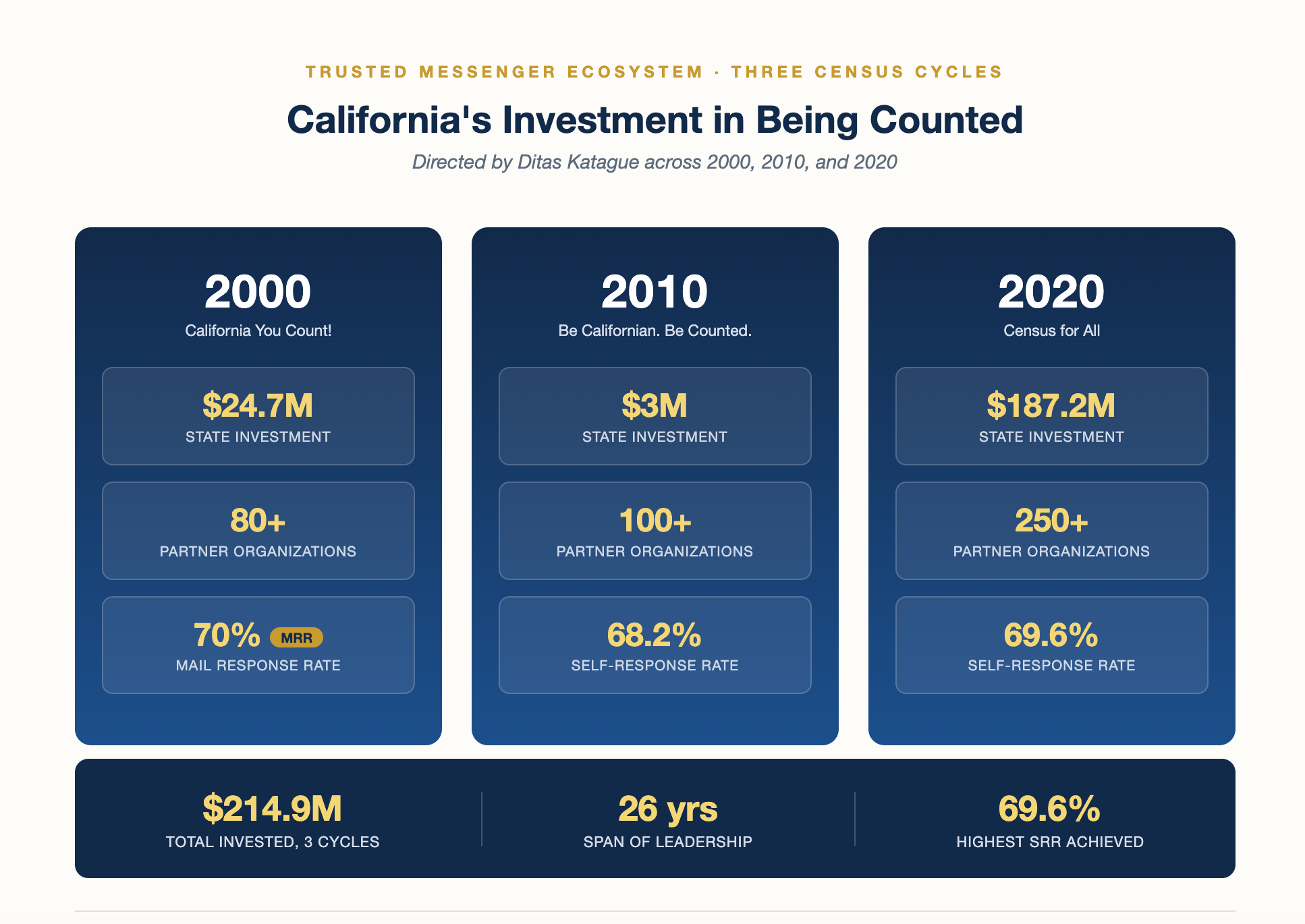
2000 figure reflects the "Mail Response Rate" (MRR) of 70% (up from 65% in 1990), the methodology used prior to the U.S. Census Bureau's shift to "Self-Response Rate" (SRR) terminology in 2010, which added internet and phone response channels alongside mail. California was one of only five states nationally to meet the Census Bureau's "90 Plus Five" challenge in 2000. 2010 SRR of 68.2% is derived from the California Census 2020 Assessment Report's statement that the 2020 SRR (69.6%) exceeded the 2010 final SRR by 1.4 percentage points. Partner organization counts (80+ in 2000, 100+ in 2010) include county and local government partners alongside community-based organizations. Investment figures: 2000 — ~$25M appropriated by the Legislature (California Department of Finance, Demographic Research Unit, "The Improvement in California's Mail Response Rate in Census 2000," January 2001); 2010 — $3M [source pending]; 2020 — $187.2M over four years, 2017–2021 (California Complete Count – Census 2020 Final Report).


“A message without a trusted messenger is just noise.”
-Ditas Katague

Explore All Services
The Ditas Group advises and architects. Our value is in the strategy, the framework, and the relationships that make implementation possible. We work with government agencies, philanthropic institutions, and civic-sector and private-sector organizations that need to reach the people civic systems most often miss.
-
For organizations seeking to invest in Census 2030, we provide the strategic counsel no one else can: what the landscape looks like, where the gaps are, how to structure public-private partnerships, what you should be doing right now, and how to measure impact. We are currently advising Philanthropy California on Census 2030 framework development and are available to advise additional government, philanthropic, corporate, and advocacy coalition clients.
We take the high-level road maps to 2030 and help you develop your specific itinerary, helping foundations, advocates, and government officials understand what they should be doing, when, and how to prepare for the 2030 Census.
Learn More -
We design the community-rooted outreach infrastructure that gets results where traditional communications fail. That includes identifying the right messenger networks, building the partnership architecture, and creating the engagement logic that connects institutional goals to community trust.
Learn More -
We build the tables that need to exist and facilitate the relationships that make them productive. This includes cross-sector coalition design, intergovernmental coordination, and public-private partnership strategy.
Contact Us -
We deliver the tools and training organizations need to move from transactional outreach to durable engagement, including our signature framework, the Layered Convening Model. The model recognizes that different stakeholders need to be engaged differently, at different levels, through different relationships, and in a deliberate sequence that builds trust before it asks for buy-in. We design the full engagement architecture: who needs to be at what table, in what order, with what purpose, and how those conversations connect to decisions.
Contact Us -
We help organizations define their role, goals, and theory of change for complex civic engagement efforts, from statewide voter education campaigns to multi-year census investment strategies. We ask the hard questions about where resources should go and why, and build the frameworks that keep coalitions aligned over time.
We’ve Worked With
-
California Democracy Partnership
-

Philanthropy CA
-
By the People, for the People
-
Evelyn & Walter Haas Jr. Fund
-
Catalyst California